A History of Iconic Sports Game Franchises: FIFA, NBA 2K, and Madden
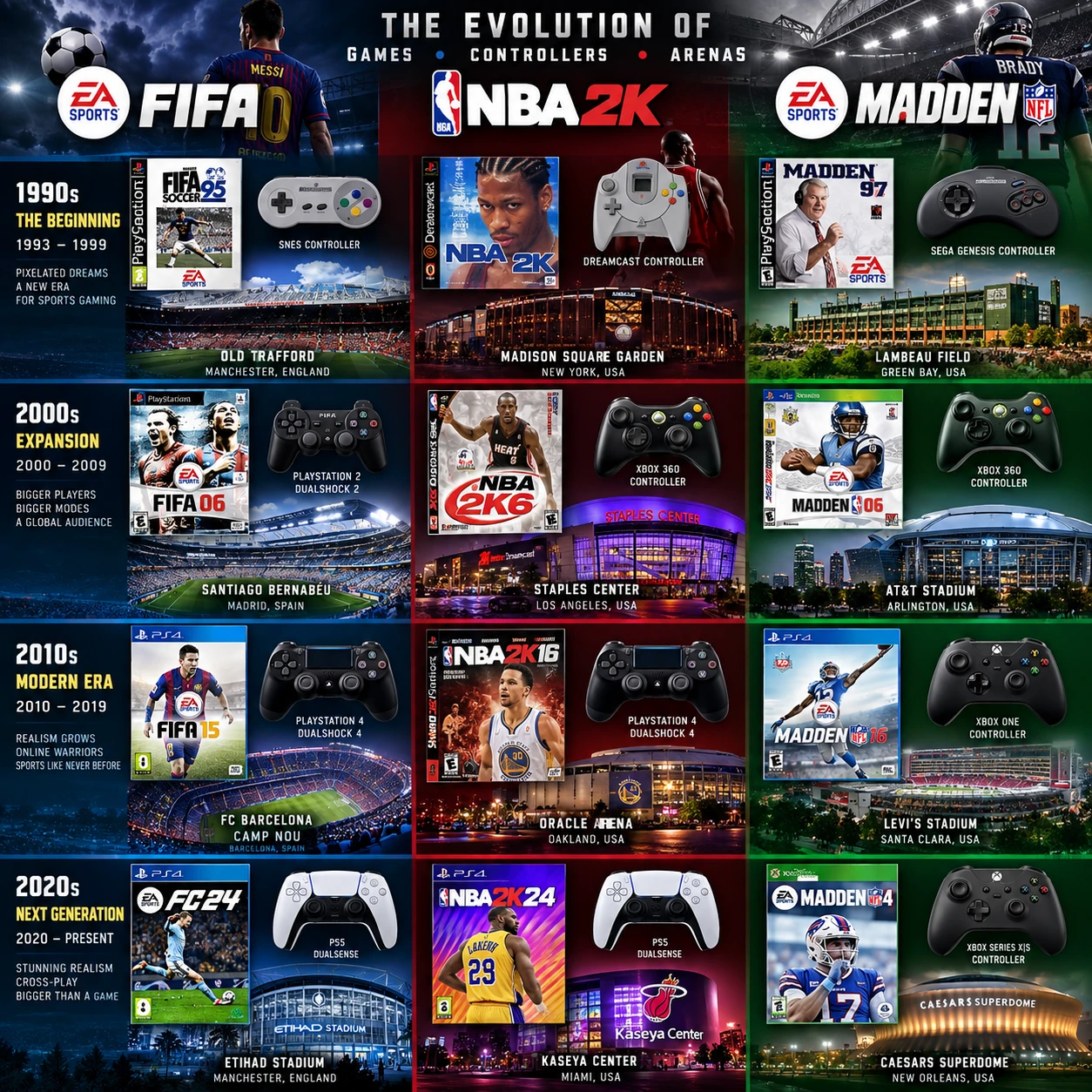
For generations of players, sports games have offered a way to take control of a favorite team, recreate a defining moment, or build a career from the ground up. FIFA, now known as EA Sports FC, NBA 2K, and Madden NFL each found a different route to becoming household names in sports gaming.
Their histories share a common engine: recognizable leagues and athletes, annual releases, and the promise of a more convincing simulation. But each franchise has also had to adapt to new consoles, online competition, and in-game economies. Understanding those changes explains why these games remain part of sports culture, while also clarifying how video-game competition differs from real-world sports betting.
The rise of annual sports games
Annual sports games became a reliable format by combining licensed teams and athletes with familiar gameplay that could be updated each season. Players knew the basic experience, while new rosters, features, and technology gave them a reason to return.
Licensing helped turn a generic sports title into a recognizable season. Official team names, uniforms, stadiums, and player likenesses made it easier to imagine managing a real club or calling plays for a favorite team. In football, basketball, and American football, that connection gave each game a built-in audience.
The yearly cycle also shaped expectations. A new edition could reflect roster moves and rule changes, improve graphics or controls, and adjust modes without asking players to learn an entirely new game. That consistency was a strength, though it created a trade-off: some annual releases felt more like refinements than dramatic reinventions.
Sports simulation became the central promise. Developers aimed to represent how a match or season unfolds, while balancing realism against responsiveness and fun. As consoles improved, the games added more detailed arenas, animations, commentary, and tactical options. The result was a familiar format that could keep changing at the edges.
FIFA’s journey from football game to global phenomenon
FIFA grew from a licensed football series into a global gaming institution by pairing international teams and competitions with increasingly detailed play and online modes. Since the franchise’s launch in the 1990s, its reach has been reinforced by the worldwide appeal of association football.
Early entries established the basic attraction: pick a national side or club, then play a match with the names and kits fans recognized. Over time, broader league and competition licenses made the virtual world more convincing. Improvements to passing, movement, defending, and ball physics also shifted the series toward a deeper simulation, though players could still favor fast, arcade-like attacks.
Modes expanded the appeal beyond a quick match. Career play let users guide a club or player over multiple seasons, while online multiplayer made it possible to test skills against people outside the living room. Ultimate Team added squad-building through player cards and team chemistry, creating a collection loop alongside the football itself.
That mode also marked a major change in how players engaged with the series. Building a competitive squad could involve time, earned rewards, or optional purchases, and the balance between those paths has been a recurring point of discussion. In 2023, EA ended its long-running FIFA branding partnership and continued the series as EA Sports FC. The name changed; the licensed football structure and annual-release expectations continued.
NBA 2K’s evolution in basketball simulation
NBA 2K built its identity around detailed basketball simulation, broadcast-style presentation, and modes that let players shape both an individual career and a team. Its focus on the NBA’s recognizable players and arenas helped make each edition feel like an interactive season.
Across successive releases, the series worked to capture the flow of basketball: spacing, player movement, defensive matchups, and the timing of a shot. Presentation became part of the experience, too. Arena details, commentary, introductions, and broadcast cues helped make a game feel closer to watching an NBA matchup, while still leaving room for players to set the pace.
MyCAREER puts a created player at the center of a personal journey, from developing skills to competing at the highest level. Franchise-style team management, often represented through MyNBA, gives users control over rosters and seasons. Meanwhile, MyTEAM offers a card-based team-building mode that brings together players from different eras.
These modes broadened the series beyond head-to-head matches, but they also brought more menus, progression systems, and optional spending. For a player who wants a straightforward basketball game, that added complexity can be a barrier. For someone who enjoys long-term roster building, it can provide a reason to return well after learning the controls.
Madden and the changing NFL gaming experience
Madden NFL developed from a football simulation into a yearly NFL platform for match play, career progression, and team management. Its enduring appeal comes from translating the league’s strategic rhythm into controls that work for both casual players and football enthusiasts.
The series has long emphasized the details that make American football distinct: formations, play selection, field position, and the interaction between offense and defense. Official NFL teams and players anchor the experience, while updates to animations, playbooks, and presentation aim to reflect the changing sport. A good simulation has to make those choices meaningful without requiring a player to study a real coaching manual.
Franchise mode lets users manage a team across multiple seasons, handling decisions such as roster construction and player development. Career-focused play offers a more personal route through the sport, while online multiplayer brings competitive matchups beyond local play. Madden Ultimate Team added a card-based squad-building layer, similar in broad structure to Ultimate Team in FIFA and MyTEAM in NBA 2K.
Each path serves a different audience. Franchise play rewards patience and planning; online games test execution under pressure. The challenge for an annual release is to improve both while preserving the reliable controls and rules fans expect. Changes that make the game more realistic may also make it less accessible to a newcomer, so developers must balance depth with clarity.
What changed across all three franchises
FIFA, NBA 2K, and Madden changed most through better technology, connected play, and progression systems that keep users engaged between matches. Their shared annual format remains, but the experience now extends far beyond a single season or local multiplayer session.
More powerful hardware brought sharper visuals, richer stadiums, and more varied animations. Online multiplayer then changed the social side of sports gaming: friends could play from different homes, and ranked competition gave skilled users a way to measure themselves against a wider field. Career and franchise modes also grew more detailed, with long-term choices replacing the simple loop of match, score, and restart.
In parallel, Ultimate Team, MyTEAM, and similar modes introduced virtual currencies, card collections, and rotating rewards. These systems can make squad-building engaging, but they can also compete for a player’s time and money. Optional purchases are not the same as required spending, yet the structure can make it difficult to tell whether a stronger team comes from skill, time invested, or money spent.
Player expectations have changed, too. Fans want current rosters and polished online services, but they also judge whether a new edition offers enough meaningful improvement to justify another purchase. Annual releases keep the games current; they can also leave limited time for sweeping changes between editions.
Sports games, esports, and betting culture
Esports competitions in FIFA or EA Sports FC, NBA 2K, and Madden are contests played within video games; sports betting involves wagering on the outcome of real sporting events. The two can share fans and sports knowledge, but they are different activities with different rules and risks.
Organized esports can include tournaments, leagues, and online qualifiers where players compete using the game’s mechanics. Results depend on factors such as skill, tactics, settings, and the particular title’s rules. A virtual match does not determine what happens in a real football, basketball, or NFL game, and performance in one does not guarantee success in the other.
Sports betting, by contrast, involves placing money or another stake on real-world sporting outcomes, where uncertainty remains even when a bettor knows the teams well. A video game’s Ultimate Team pack or MyTEAM card is also not the same thing as a bet on a real match. These features belong to the game’s own economy and should be understood separately from wagering.
For readers interested in both subjects, a useful distinction is to ask what is being competed over and what determines the result. If players are competing under a video game’s rules, it is esports. If money is staked on a real sporting event, it is betting. Keeping that line clear helps fans enjoy sports games without confusing virtual competition with real-world wagering.
Frequently asked questions
How often do FIFA, NBA 2K, and Madden games release?
All three franchises have generally followed an annual release schedule, with a new edition tied to each sports season. Release plans can vary, so check the publisher’s official announcements for current dates and availability.
What is the difference between a sports simulation and an arcade-style game?
A sports simulation aims to represent the sport’s rules, tactics, and movement in detail. An arcade-style game usually prioritizes quick action and simpler controls, even if it bends realism for speed or spectacle. Many major sports titles mix both approaches.
How have online modes changed sports gaming?
Online multiplayer lets users compete with friends and strangers beyond local play. Ranked modes, co-op, and card-based team-building also create longer-term goals, though they can bring added complexity and optional spending.
Are esports competitions in these games the same as sports betting?
No. Esports competitions test performance within a video game, while sports betting involves wagering on real sporting events. They may attract overlapping audiences, but the competition, outcome, and risks are distinct.